Automation Settings
Your ability to access account settings may depend on the permissions setup by your organization.
Within Account Settings easily control the settings of automations launched within your Paminga account. These settings will be applied to all automations created once set.
To get to these settings navigate to your user in the top right corner and select "Account Settings". On the left hand side, expand the options and select "Automation Settings".
The settings you can control here include:
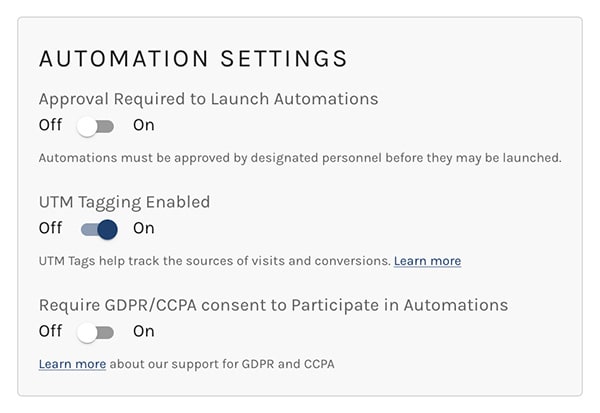
- Approval Required to Launch Automations
- UTM Tagging Enabled
- Require GDPR/CCPA consent to Participate in Automations
- Require Consent to Track Email Opens
- Mark Contacts Bounced After Repeated Soft Bounces
Approval Required to Launch Automations
When this selection is enabled any time a campaign is saved by a user that is NOT a campaign approver, they will be prompted to "Save and Request Approval". There will be a drop down of the campaign approval users that can approve the campaign for launch. The user can select one user, or any combination of approvers to send the notification of approval to.
Once selected an email will be sent to the campaign approval users, who can review and launch the automation.
UTM Tagging Enabled
When this checkbox is selected UTM tagging will be automatically emailed in the email builder as well as the automation settings. Paminga will apply UTM Content based on the name of your email or automation.
If at any time you would like to update these to something different when this checkbox is enabled, easily do so via the settings of either the email or automation.
Require GDPR/CCPA consent to Participate in Automations
If you actively use GDPR/CCPA conset checking this checkbox will make it so any automation created in your account will have this checkbox selected. When selected Paminga will only send emails to contacts who have consented.
Require Consent to Track Email Opens
When this is on, every automation you create from then on starts with its Only track email opens for Contacts who have granted Email Tracking Consent checkbox selected, and emails Paminga sends outside an automation (form autoresponders, action sets) follow this setting directly. Contacts whose Email Tracking Consent is Unknown are then sent without the open pixel; contacts who have granted are tracked, and contacts who have denied are never tracked regardless of this setting.
This is what France's CNIL rules on email tracking pixels call for. See Email Tracking Consent for how consent is collected and honored.
Mark Contacts Bounced After Repeated Soft Bounces
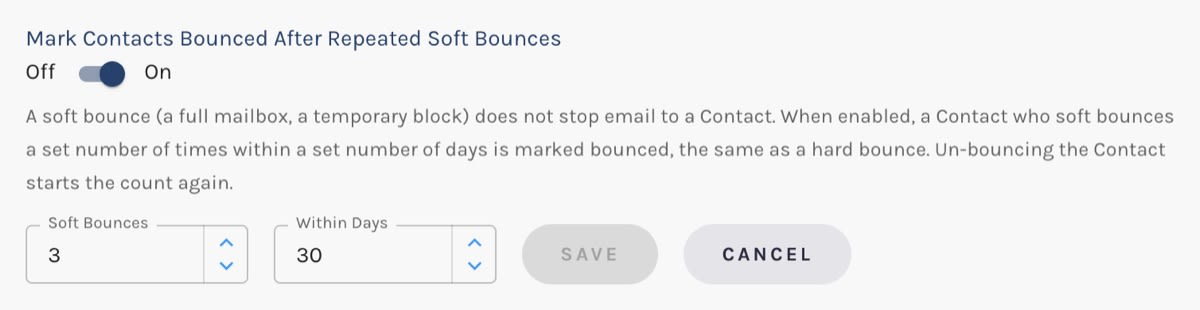
A soft bounce is a temporary delivery failure: a full mailbox, a receiving server that is temporarily blocking mail. A single soft bounce never stops email to a Contact. By default, only a hard bounce marks a Contact bounced; with the setting below turned on, repeated soft bounces can too.
That is the right default, but an address that soft bounces send after send is not doing your sender reputation any favors either. This setting lets you draw the line. It is Off by default.
When you switch it On, two fields appear:
- Soft Bounces – how many soft bounces it takes. Defaults to 3.
- Within Days – how many days back Paminga looks when counting them. Defaults to 30.
Each must be a whole number of at least 1. Click Save to apply new values; the On/Off switch itself saves as soon as you flip it.
Mark Contacts Bounced After Repeated Soft Bounces:
What Happens When a Contact Crosses the Threshold
Each time a Contact soft bounces, Paminga counts that Contact's soft bounces in the number of days you set, looking back from that bounce. Bounces on the same send count once. When the count reaches your Soft Bounces number, the Contact is marked bounced exactly as a hard bounce would mark them:
- They are filtered out of future mailings.
- The Bounce Reason under their Mailable Status reads like "Promoted: 3 soft bounces in 30 days".
- The bounce is sent up to your connected CRM the same way a hard bounce is.
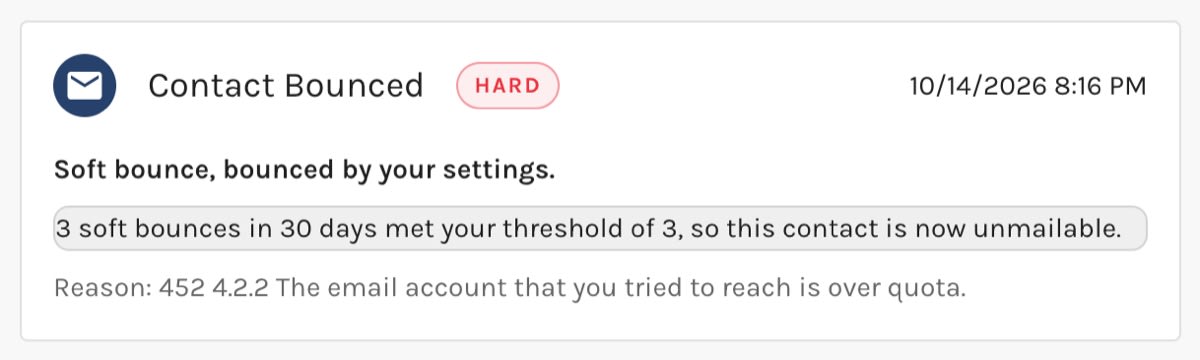
- Their Activity Stream gets a Soft bounce, bounced by your settings. entry that records the count, the window, and the threshold that applied at the time, along with the receiving server's own reason for the bounce that tipped it.
The bounce stays until the Contact is unbounced. When you unbounce them, the count starts over: only soft bounces after the unbounce count toward marking them bounced again.
A Contact Marked Bounced by Repeated Soft Bounces:
Turning this setting on (or lowering the numbers) does not reach back and bounce Contacts on its own. It is checked each time a Contact soft bounces: Paminga counts that Contact's soft bounces within the window, ending at that bounce, and marks the Contact bounced only if the count reaches the threshold.
Communication Limits
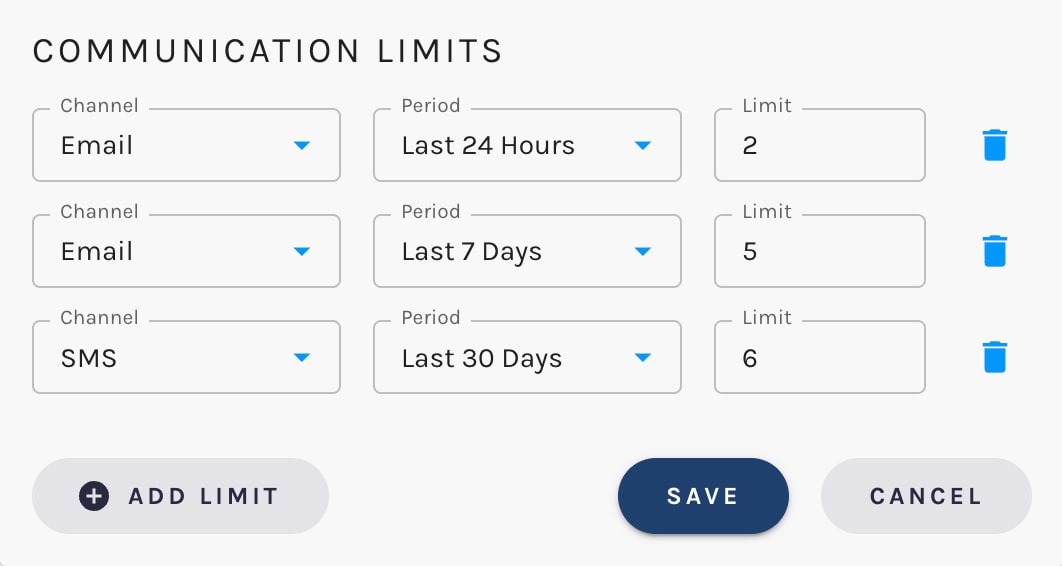
Communication limits can be set to prevent over-communication on a per-channel basis.
Limits can be set for the following periods:
- Last 24 hours
- Last 7 days
- Last 30 days
- Last 90 days
An Activity Stream entry is made when an email is not sent due to communication limits.
Bypassing Communication Limits
Communication limits are automatically bypassed when sending transactional emails.