The Foundation Every Paminga IQ Agent Reads From
Your Business Profile is how Paminga IQ understands your organization before it writes a word. Run it once against your domain and it builds a complete picture of your company, your brand voice, and your ideal customers — automatically, from what already exists on your website.
Every agent in Paminga reads this profile every time it creates something for you. It’s what separates outputs that sound like you from outputs that sound like everyone else.
One Run. Always Current.
Point it at your domain. It figures out the rest.
Built from your website. Refined by you.
The discovery agent reads your public-facing content and structures what it finds into a Business Profile your team can review and edit. Everything it identifies — from your value propositions to your vocabulary preferences — is editable before any agent uses it.
When your messaging changes, run discovery again. The profile updates. Every agent reads the new version from that point forward.
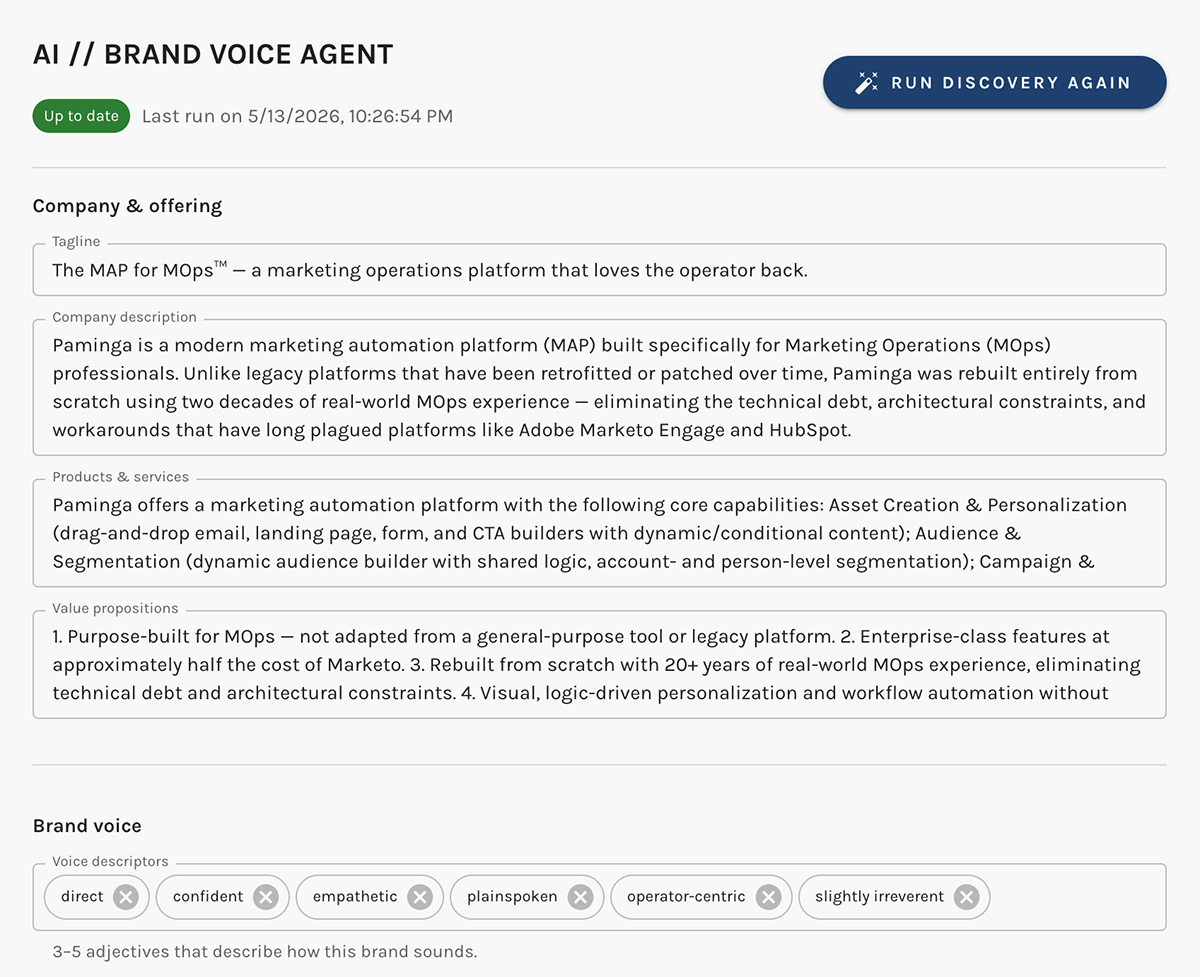
The screenshots on this page are from Paminga’s own Business Profile — run against paminga.com. They show exactly what the discovery output looks like and how agents use it when creating assets for us.
What the Business Profile Captures
Everything an agent needs to write like you.
The Business Profile isn’t a general description of your company. It’s a structured set of inputs agents reference when making decisions about language, tone, positioning, and audience — every time they create something for you.
Company Description & Tagline
Who you are and how you describe yourself — the foundational context every agent uses before writing a single line of copy.
Products, Services & Value Props
What you offer and how you position it — so copy leads with the right benefits and uses the language your buyers recognize.
Voice Descriptors
The adjectives that define how your brand sounds. Agents use these to calibrate tone across every asset they produce for you.
Formality & Emoji Policy
How formal your brand is and whether you use emoji — freely, sparingly, or not at all. Applied to every piece of copy an agent produces.
Voice Sample URLs
Pages from your website the discovery agent reads to calibrate against how you actually sound — not just how you describe yourself. Re-read on each discovery run for a stronger signal.
Ideal Customer Profiles
Up to three ICPs identified from your website — each with industries, company sizes, geographies, buyer roles, pain points, and goals. Selectable at the asset level to shape copy for a specific buyer.
Brand Voice
Not just tone. Actual vocabulary.
Vocabulary that goes both ways.
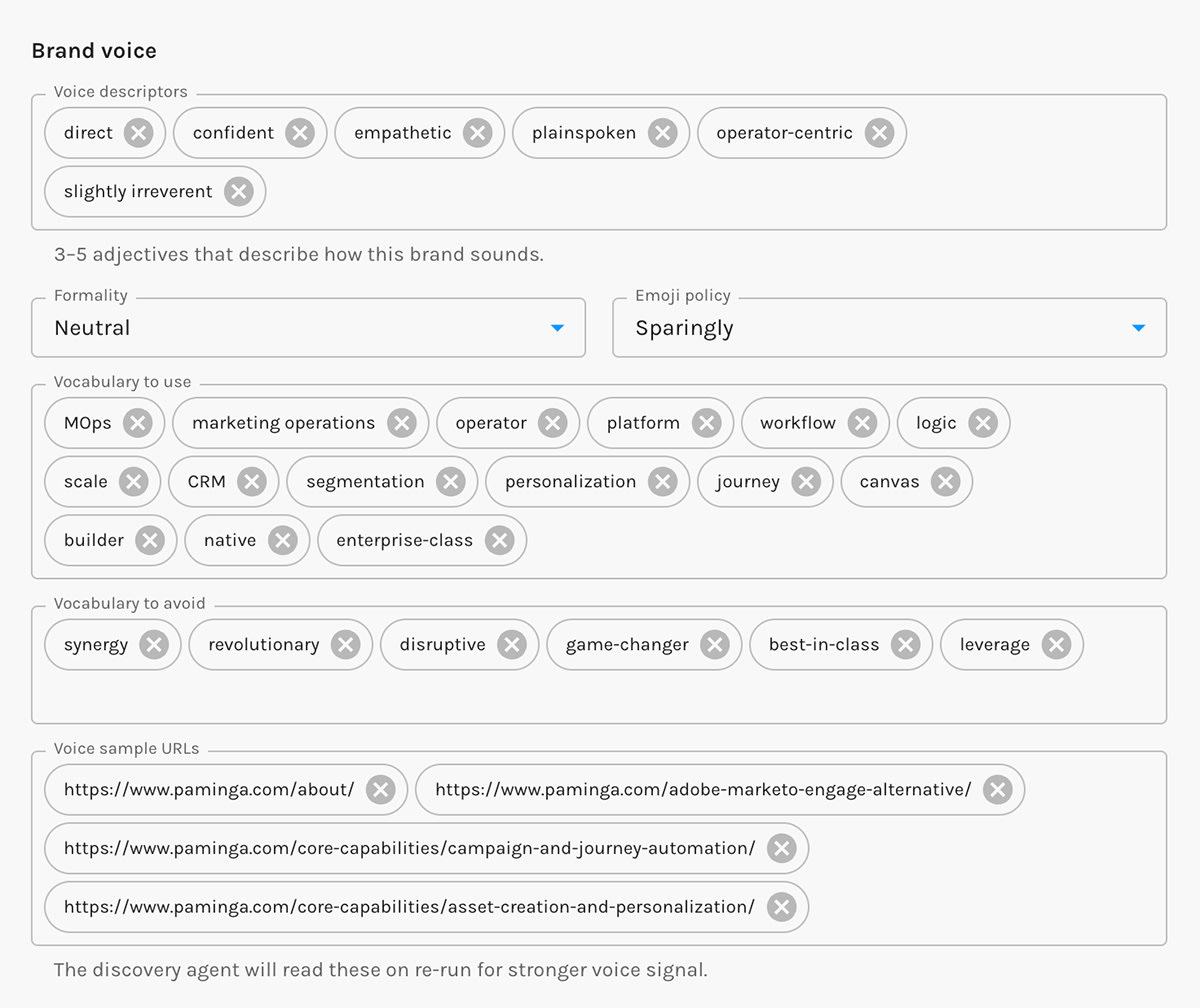
The Business Profile captures vocabulary to use — the specific terms your brand leans on — and vocabulary to avoid. Both matter equally. Knowing not to write “synergy” or “game-changer” is what keeps outputs from sounding generic.
When Paminga IQ ran discovery on paminga.com, it identified our voice descriptors as: direct, confident, empathetic, plainspoken, operator-centric, and slightly irreverent. Formality: neutral. Emoji: sparingly. Those inputs shape every asset our agents produce.
Ideal Customer Profiles
Copy shaped around the buyer who’s reading it.
The depth that makes ICP-aware copy actually different.
When Paminga IQ ran discovery on paminga.com, it identified three ICPs. Each one includes buyer roles, pain points written in plain language, and goals that reflect what that buyer actually needs — not a generic persona description.
That specificity is what makes ICP selection meaningful. The same prompt produces different copy when the agent knows whether it’s writing for a MOps Manager evaluating Marketo alternatives versus an IT Director concerned about CRM integration overhead.
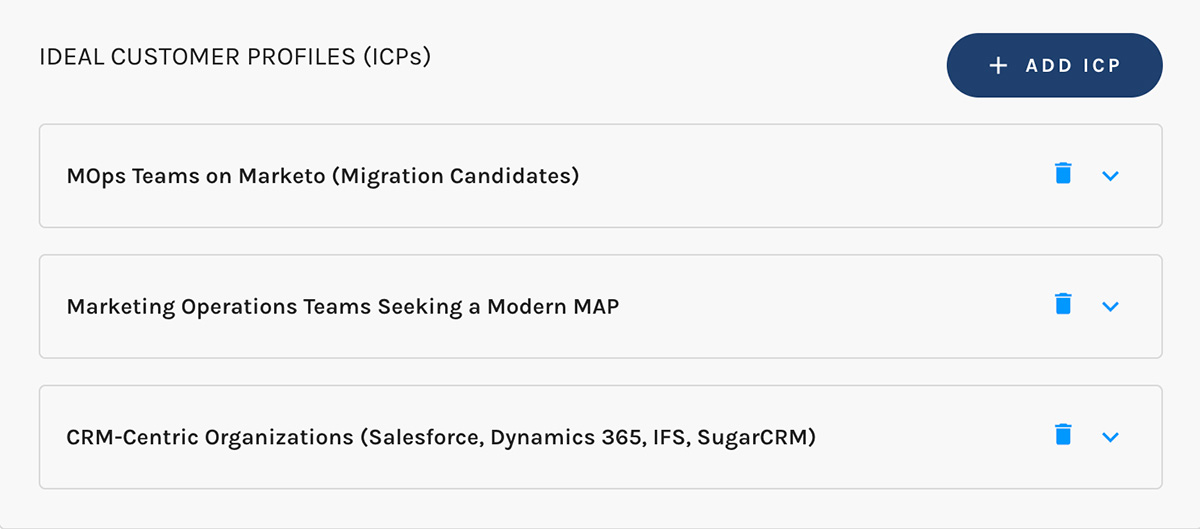
MOps Teams on Marketo (Migration Candidates)
Marketing Operations professionals and teams currently using Adobe Marketo Engage who are frustrated by high costs, technical debt, limited innovation, and the need for expensive consultants just to operate the platform.
Paying ~$250/hour for vendor guidance with no actual work done; working around platform limitations rather than solving problems; accumulated technical debt and architectural constraints; needing consultants to use basic features.
Replace Marketo with a modern, enterprise-class MAP at roughly half the cost; eliminate workarounds; gain a platform that scales without accumulating clutter or debt; work with a vendor that behaves like a partner.
Marketing Operations Teams Seeking a Modern MAP
MOps teams who know their current platform is a constraint but aren't necessarily on Marketo. Motivated by maintainability, self-service data control, and modern UX.
Platform complexity that slows the team down; limited self-service for data and integrations; UI that feels like it was built a decade ago; vendor roadmaps that don't reflect how modern MOps teams work.
A MAP the team can actually own; faster campaign execution; self-service integrations without admin bottlenecks; a platform they can grow into rather than out of.
CRM-Centric Organizations (Salesforce, Dynamics 365, IFS, SugarCRM)
Organizations where the CRM is the system of record and MAP integration quality is the primary evaluation criterion. Often running non-Salesforce CRMs that most MAPs treat as an afterthought.
Most MAPs were built for Salesforce and retrofitted for everything else; middleware and custom connectors to maintain; sync delays that make the MAP feel perpetually out of date with the CRM.
A native integration with their actual CRM; self-service field mappings without admin tickets; sync throughput that keeps the MAP current; no middleware to maintain or budget for.
Why It Matters
Set it once. Every agent reads it every time.
You don't re-explain your brand in every prompt. Your voice, your vocabulary, your positioning — captured once in the Business Profile and applied automatically every time an agent creates something for you.
Vocabulary to avoid is as valuable as vocabulary to use. Knowing not to write "synergy" or "game-changer" is what keeps outputs from sounding generic. The Business Profile captures both sides of that equation.
ICP selection changes what gets written — not just how it sounds. The pain points the copy leads with, the goals it speaks to, the language it uses — all of it shifts when an agent knows which buyer it's writing for.
It stays current. Run discovery again when your messaging evolves. The profile updates and every agent reads the new version immediately — no re-configuration required.
Everything is editable. The discovery agent gives you a strong starting point. You review, refine, and save. The profile is yours to control — the agent just does the heavy lifting of building the first draft from your website.
See It in Action
See what the Business Profile produces from your domain — and how it shapes what Paminga IQ writes.


Built with pride in Denver, Colorado, USA
Copyright © Paminga, Inc. 2026All rights reserved. Various trademarks held by their respective owners.